# Raios360 - Field Operations Management Platform
**One Platform. More Reliable Teams.**
**One platform for more reliable inspections, audits, field work, compliance, maintenance, and AI-powered reporting.**
Raios360 is the multi-tenant SaaS field operations platform that senior operations leaders run the business on. It leads with four things decision-makers care about: (1) built-in AI that drafts the report, flags the anomaly, and answers the operational question; (2) reliable data that stays accurate and available offline and reconciles when it matters; (3) enterprise-grade security with strict tenant isolation you can defend to your board and auditors; and (4) trust earned over years serving real businesses in the field. From task assignment to form collection, serial and lot tracking to board-ready reporting, Raios360 coordinates your entire mobile workforce.
## Key Features
### Work Management
- **Projects**: Create and manage projects with custom statuses, priorities, and timelines. Link tasks, forms, and submissions for complete traceability. Project templates for recurring work.
- **Tasks**: Assign to individuals or teams with due dates. Full lifecycle: assign, accept, start, pause, complete, verify. SLA tracking with breach notifications. Task rework for quality control.
- **Forms**: Visual form builder with 50 field types including check-in location (GPS + timestamp proof). Version control, conditional logic, real-time validation. Data lookup fields for clients, products, serials, lots, databases. Barcode/QR scanning across products, serials, lots, and custom databases.
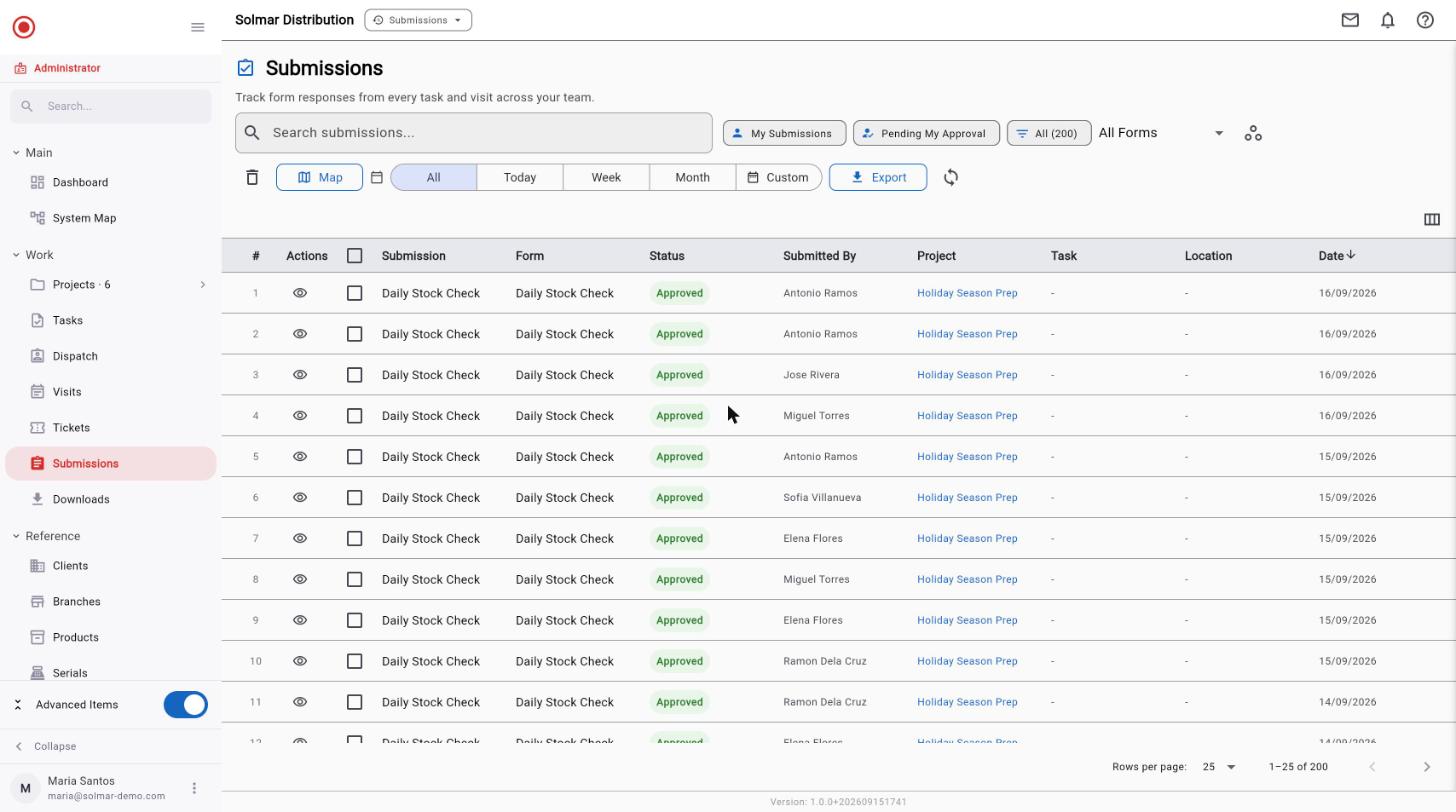
- **Submissions**: Approval workflows with multi-level chains. Full audit trails with metadata (device, location, network, duration). Resubmission workflow. Archive and export.
### Field Operations
- **Scheduled Visits**: Plan field visits to client locations. Purposes: sales, support, delivery, inspection, maintenance, follow-up. Calendar integration. Status tracking.
- **Geolocation Check-In/Out**: GPS-verified arrival/departure. Location + timestamp for compliance. Duration tracking, overdue detection. Visit outcome recording.
- **Attendance Tracking**: Clock in/out with GPS verification. Break management. Team dashboard. Geofencing support.
### Data Management
- **Client Database**: Contact info, multi-location branches, 15 custom field types, linked tasks/visits/submissions.
- **Product Catalog**: FMCG-ready. SKU, barcode, brand, category. Multiple price types (retail, wholesale, promotional, cost). Price groups. CSV import/export.
- **Serial Tracking**: Track serialized assets through their full lifecycle. Serial numbers with per-unit warranty tracking. Client and sales rep linking. Financial tracking (discount, tax, payment method). Buyer information capture. Supplier and delivery management.
- **Lot Tracking**: Manage batch and consumable goods with lot numbers, expiry dates, and quantity tracking. Link lots to products, clients, and form submissions.
- **Custom Databases**: Unlimited databases with custom schemas. Full-text search. Offline sync. Barcode lookup in forms.
### Reporting & Analytics
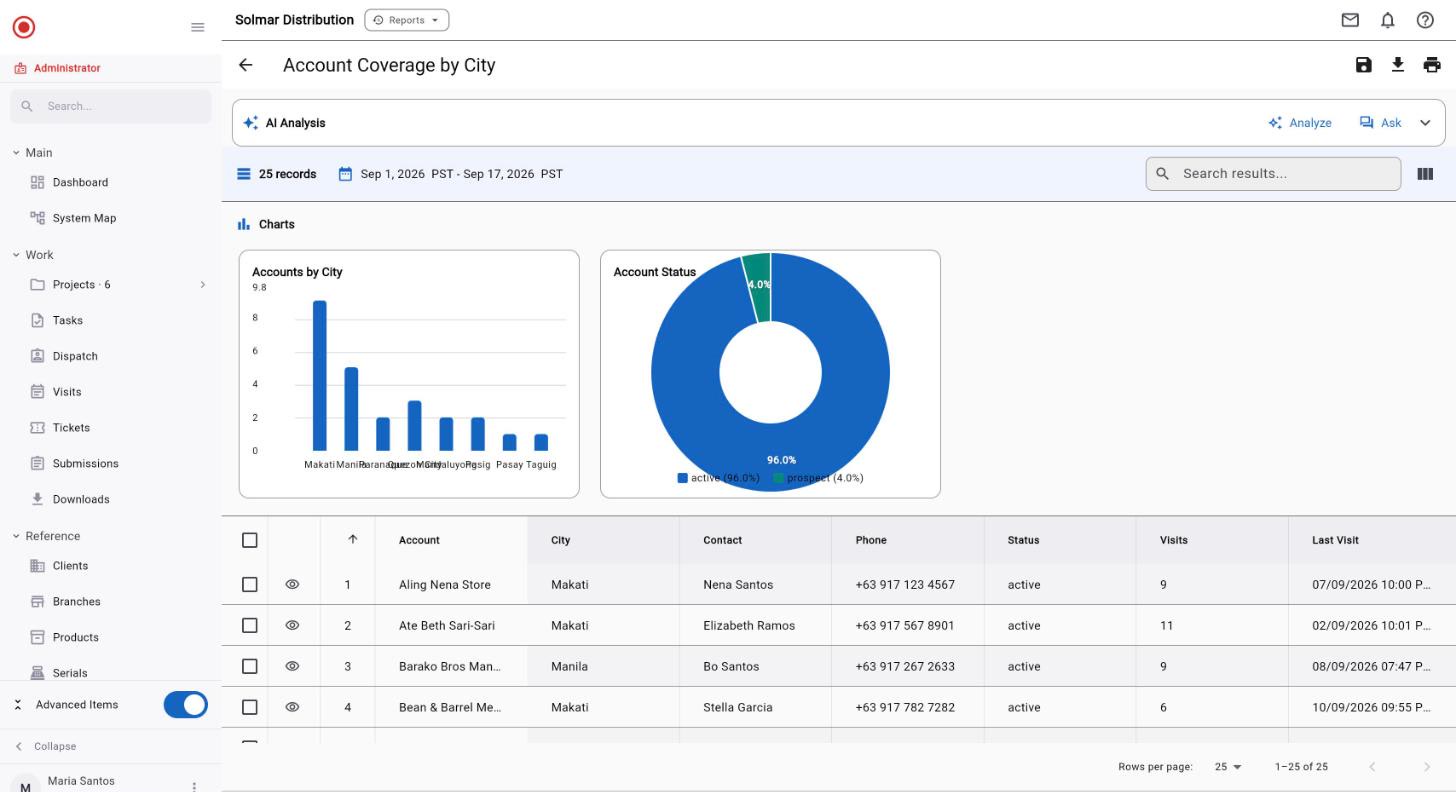
- **Report Builder**: Basic and advanced. Multi-form sources, cross-form joins. Aggregations (sum, avg, count, min, max, median). Calculated fields. AND/OR filters.
- **Chart Builder**: 8 types: bar, line, pie, donut, area, scatter, heatmap, table. Live preview. Custom styling.
- **Export**: PDF with company branding, Excel/CSV, scheduled delivery, report archive.
- **Dashboards**: Real-time KPIs, task completion rates, submission trends, visit statistics.
### AI & Integration
- **AI Analytics Assistant**: Natural language data queries. Auto chart/table generation. Conversation history. Supports OpenAI, Anthropic, Google AI, Azure. Organization's own API key.
- **MCP Server**: 26 tools (12 read, 14 write). Permission-bounded. 7 schema resources. 5 prompt templates. Connect Claude Desktop, IDE plugins, custom apps.
- **API Access**: REST API for submissions and reports. API keys with scopes and quotas. Audit logging.
### Team Management
- **Users**: Email invites, multi-org support, admin password reset, activity tracking.
- **Groups**: Hierarchical structure, group leaders with scoped access.
- **Roles & Permissions**: 7 built-in roles. Custom roles. 162 permission combinations (18 resources x 9 actions). Quick and Advanced permission pickers.
### Communication
- **Messaging**: Direct messaging, tap-to-acknowledge, read receipts, threads, channels.
- **Push Notifications**: Task, submission, visit, and message alerts. Multi-device. Deep linking.
- **Notification Center**: Centralized inbox, read/unread, date grouping.
## Platform
- Multi-tenant with complete data isolation
- Module feature toggles (Clients, Products, Serials, Lots, Databases, Workflows)
- Self-service registration with trial period
- Cross-platform: Flutter for web, iOS, Android
- Full offline mobile support with automatic sync
- Human-readable IDs (Dated, Org-Prefixed, Simple formats)
## Applications
- **Web App**: Dashboard, project/task management, form builder, submission review, visit scheduling, data management, report builder, team admin, settings.
- **Mobile App**: Task execution, form filling with photos/signatures/barcodes, GPS check-in, attendance, product/serial browser, offline mode, messaging.
- **Admin Portal**: Organization management, module toggles, user admin, templates, subscription plans, platform analytics.
## Industries
FMCG & Retail, Field Services, Healthcare, Construction, Logistics, Agriculture, Utilities, Real Estate, Local Government, Security Teams.
## Pricing
- **Free Trial**: 30 days, all features, unlimited users, no credit card required
- **Standard**: $18/user/month ($15/user/month billed annually — save 17%)
## Links
- Register: https://app.raios360.com/register
- Login: https://app.raios360.com/login
- Website: https://raios360.com
- Product Brochure (PDF): https://raios360.com/raios360-brochure.pdf
One platform for more reliable inspections, audits, field work, compliance, maintenance, and AI-powered reporting.
Paper, spreadsheets, or a real system of record?
Most field teams have outgrown their tools without noticing. Raios360 leads where it matters to leaders: built-in AI that drafts the report and flags the anomaly, reliable data that holds up offline, enterprise-grade security you can defend to your board, and a track record earned over years with real field teams.
30 days free · No credit card required
Side by side
What each approach can — and can't — do
Grouped by the four things operations leaders weigh. A checkmark means it is handled well; amber means partial or with workarounds.
| Paper forms | Spreadsheets | Generic field apps | Raios360 | |
|---|---|---|---|---|
| AI integration | ||||
| AI drafts the report and flags anomalies | ||||
| Ask your data questions in plain English | ||||
| Data reliability | ||||
| Keeps working with no signal | ||||
| Syncs itself when connectivity returns | ||||
| Captured once — no re-keying or transcription errors | ||||
| Real-time "who’s on site now" | ||||
| Security & privacy | ||||
| Per-user/role access, audit trail, data recovery | ||||
| Tenant isolation and board-defensible security | ||||
| Depth & trust | ||||
| Photos, GPS, signatures captured in context | ||||
| GPS-verified that the visit happened where it should | ||||
| Work assigned as trackable field tasks | ||||
| Workflow automation (approvals, routing) | ||||
| Mobile app built for the job | ||||
| Scales across teams, sites, and industries | ||||
| Proven over years with real field teams | ||||
Handled well Partial / workaround Not really Not applicable
An honest look
Every tool earns its place — until the work outgrows it
We are not here to bash paper or spreadsheets. They work, right up to the point where they quietly cost you time, accuracy, and control.
Where paper still makes sense — and where it breaks
Paper needs no signal, no battery, and no training. For a one-off checklist far from anywhere, it is hard to beat.
But paper has to be driven back, typed up, and filed. Forms go missing. Numbers get re-keyed with errors. You cannot see who is on site right now, and last quarter’s records are in a box somewhere.
That is a data-reliability gap: the record only becomes useful long after the work is done — if it survives the trip at all.
Where spreadsheets shine — and where they strain
Spreadsheets are flexible and everyone knows them. For a small team and a simple tracker, they get you moving today.
But they were never built for the field. There is no offline capture on a phone, no controlled access, no audit trail, and one wrong paste can overwrite a month of work. As teams and sites grow, the file becomes the bottleneck.
That is a security-and-reliability gap: no tenant isolation, no recovery, and no defensible record of who changed what.
Where generic field apps help — and where they stop
A point tool for photos and GPS is a real step up from paper. It captures evidence in context and often syncs to the cloud.
But most stop at capture. There is no built-in AI to draft the report or flag the anomaly, no plain-English analytics, limited role and audit controls, and little track record under real, at-scale field load.
That is an AI-and-trust gap: you still export data elsewhere to make decisions, and you are betting on a tool that has not been proven over years.
Switching is easier than staying
You can start this week
Moving off paper or a spreadsheet does not mean a long project. Bring your data, keep your phones, and start capturing cleaner records from day one.
Bring your data with you
Import clients and product catalogs from CSV, so you start with your existing records — not a blank slate.
Offline-first from day one
The mobile app captures forms, photos, GPS, and signatures without a signal, then syncs automatically when you are back online.
Low setup, fast start
Self-service sign-up with a full-featured free trial and industry templates. Turn on only the modules you need.
Runs on the phones you already have
Built with Flutter and designed for spotty data and low-end Android — the reality of most field teams.
Ready to move from paper to a system of record?
Full-featured free trial. No credit card required.